Skip to content
Linespedia

Ploughman Singing

By John Clare

Topics: classic

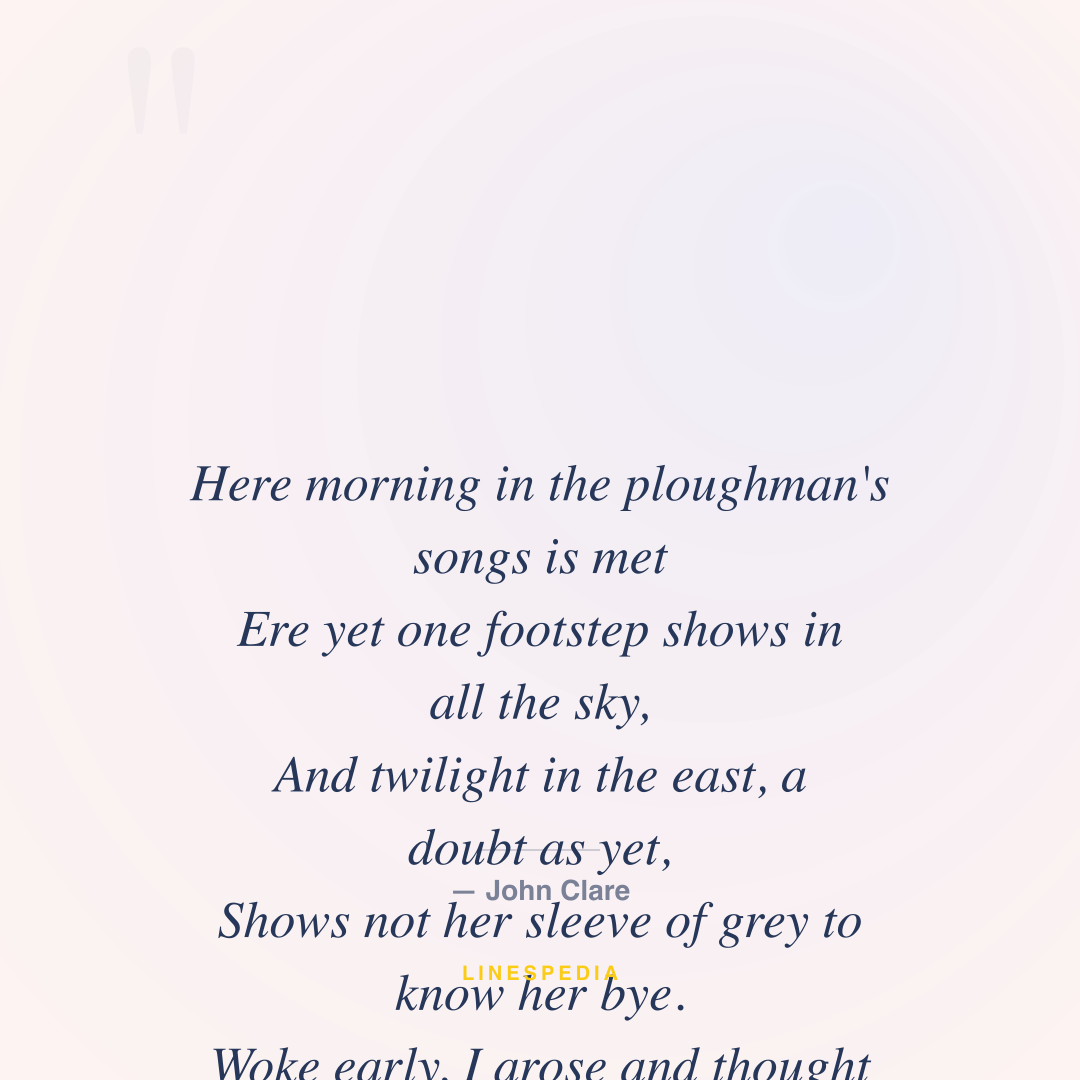
Here morning in the ploughman's songs is met     Ere yet one footstep shows in all the sky,     And twilight in the east, a doubt as yet,     Shows not her sleeve of grey to know her bye.     Woke early, I arose and thought that first     In winter time of all the world was I.     The old owls might have hallooed if they durst,     But joy just then was up and whistled bye     A merry tune which I had known full long,     But could not to my memory wake it back,     Until the ploughman changed it to the song.     O happiness, how simple is thy track.     --Tinged like the willow shoots, the east's young brow     Glows red and finds thee singing at the plough.

AI analysis available. Enable JavaScript to interact.

About this line

"Here morning in the ploughman's songs is met..."

Exploring the themes of classic, John Clare delivers a powerful performance in "Ploughman Singing"... ### Why We Love This Line At Linespedia, we believe that poetry is the ultimate sanctuary for the soul...
Attribution & Rights

Author:John Clare

"Here morning in the ploughman's songs is met..." by John Clare

For usage rights, copyright concerns, or to report an issue with this content, please visit our Copyright & Report page.

Classified Tags

Visual Poster

Download for social stories.

Ploughman Singing Poster

Related lines

"How oft on Sundays, when I'd time to tramp,     My rambles led me to a gipsy's camp,     Where the real effigy of midnight hags,     With tawny"

"The setting Sun withdraws his yellow light,     A gloomy staining shadows over all,     While the brown beetle, trumpeter of Night,     Proclai"

"Where the broad sheepwalk bare and brown     [Yields] scant grass pining after showers,     And winds go fanning up and down     The little str"

"The Text is taken from Percy's Reliques (1765), vol. i. p. 71, 'given from two MS. copies, transmitted from Scotland.' Herd had a very similar bal"

John Clare

About John Clare

John Clare (1793–1864) was an English poet known as the "peasant poet" for his humble origins. His nature poetry—including "I Am" and "Badger"—captures the English countryside with extraordinary precision and emotional honesty, and he is now recognized as one of the finest nature poets in the language.

Full Bibliography
Continue Reading

"How oft on Sundays, when I'd time to tramp,     My..."

Weekly Poetic Insight

Join our literary Sanctuary

Get the most inspiring lines, poetic analysis, and secret shayaris delivered to your inbox every Sunday.